ISSN 1884-0760
GRACE TECHNICAL REPORTS
On the use of Bidirectional Transformations
for Translational Semantics
Florent Latombe and Soichiro Hidaka
GRACE-TR 2014–01
Apr 2014
CENTER FOR GLOBAL RESEARCH IN
ADVANCED SOFTWARE SCIENCE AND ENGINEERING
NATIONAL INSTITUTE OF INFORMATICS
2-1-2 HITOTSUBASHI, CHIYODA-KU, TOKYO, JAPAN
On the use of Bidirectional Transformations for
Translational Semantics
∗
Florent Latombe
IRIT, Universit´
e de Toulouse,
Toulouse, France
Soichiro Hidaka
National Institute of Informatics
Tokyo, Japan
April 10, 2014
Abstract
In this work, we aim at defining the semantics of Executable Domain-Specific Modeling Languages (xDSMLs) in a translational way by us-ing Bidirectional Transformations written with the GRoundTram frame-work1
, where the backward transformation of GRoundTram enables us, between each step of execution of the target model conforming to the target xDSMLs (where the state of the model changes), to propagate the changes back to the state of the model conforming to the source xDSML, in coherence with the forward transformation that provides the translational semantics. It is possible to define most elements composing an xDSML using Model-Driven tools like the Eclipse Modeling Framework (EMF), however this creates a technical gap with GRoundTram which is relevant to graphs. We propose a workflow and the first steps of its implementa-tions which allows us to transform graphs into models and vice-versa for the implementation of translational semantics of an xDSML.
1
Introduction
This section introduces the context of this work in subsection 1.1, the goal of this work in subsection 1.2 and the running example used for experimentation in subsection 1.3.
∗The work presented in this technical report was done between the 7th of January 2014
and the 26th of March 2014 during an international internship at the National Institute of Informatics (Tokyo, Japan) under the supervision of Soichiro Hidaka.
1
http://www.biglab.org/
1.1
Context
1.1.1 Bidirectional Transformation
The work presented in this document relies on the GRoundTram Framework[5, 7] developed by the BiG Project2
of the NII. For more information about GRoundTram, see the project website at
http://www.biglab.org/ or contact Soichiro Hidaka. For bidirectional transformations in general, please refer to [2, 8].
1.1.2 Definition of Executable Domain-Specific Modeling Languages
The context of this work is the definition of Executable Domain-Specific Modeling Languages, hereafter refered to as xDSMLs. xDSMLs are, in particular, Domain-Specific Languages or DSLs. There exists a lot of litterature concerning DSLs and it is not the aim of this document to go into details about the practice of DSL design. What is essential to understand, is that DSLs are usually very small languages, typically not Turing-complete and designed for a very small audience (usually experts in a given field). Readers who want to know more about DSLs can have a great overview in Voelter et al.’s book
DSL Engineering. xDSMLs are also, in particular, Domain-Specific Modeling Languagesor DSMLs. DSMLs are a flavour of DSLs where the goal of the language is to model systems and their behaviours. Empirical studies have proven that the use of DSMLs by the industry is growing and requiring new techniques and tools [9]. Lastly, xDSMLs are alsoExecutable, usually through interpretation or generation (akin to compilation) and thus need clear semantics.
Defining a DSL [4] is usually done by defining an Abstract Syntax (AS) which are the concepts and relations manipulated by the domain at hand, one or several Concrete Syntaxes (CS) in order to create instances (programs), and a mapping towards a Semantic Domain (SD). The AS can easily be defined in a Model-Driven Engineering (MDE) way by defining a MetaModel (MM) using, in our case, the Ecore editor of the Eclipse Modeling Project3
. Concrete Syntaxes are usually textual (using xText4
for instance) or graphical (using Sirius5
for instance). The mapping towards the SD can be realized in different ways which will not be detailed here but can usually be categorized among one of these three families: Operational Semantics, Denotational Semantics, Axiomatic Semantics.
1.1.3 GEMOC: On the Globalization of Modeling Lan-guages
GEMOC6
is an open initiative exploring the necessary breakthrough in software languages to support a global software engineering. GEMOC
2
http://www.biglab.org/
3
http://eclipse.org/modeling/
4
https://www.eclipse.org/Xtext/
5
http://www.eclipse.org/sirius/
6
investigates tools and methods in software language engineering (SLE) for the design and implementation of collaborative, interoperable and composable modeling languages. In particular, GEMOC aims at providing technical and methodological means to reify the concurrency of languages at the language level [1]. Details about GEMOC will not be provided in this document as they are not directly relevant to the issue of translational semantics using bidirectional transformations, but any question can be redirected to Florent Latombe.
1.2
Main Goal
The methodology and tools developed in GEMOC for defining xDSMLs focus on defining the semantics of xDSMLs through an Operational Se-mantics manner. However this technical report presents an approach to-wards defining the semantics of an xDSML through a Translational Se-mantics manner. In other words, our goal is to provide the seSe-mantics of an xDSML (refered to as source xDSML) using the already well-defined semantics of another xDSML (refered to astargetxDSML). Thus the need for a transformation from source xDSML to target xDSML, also refered to as the Forward Transformation in the Bidirectional Transformations context. However, simply being able to execute a language using another language’s semantics is not enough. We want to be able to display (textu-ally or through a graphical animation) the execution while it is happening. We also want to be able to take reactive systems into account, where the user or an environment (in the case of GEMOC, usually other xDSMLs) will have the opportunity to make choices on the flow of the execution. In order to be able to do that, the AS of the source xDSML must be able to encode the state of a model conforming to the xDSML. We also need the same capacity in the target xDSML’s AS. On top of that, between each step of execution (where the state of the executed model changes), we need to propagate the changes in the state of the model conforming to the tar-get xDSML up to the state of the model conform to the source xDSML, in coherence with the Forward Transformation mentioned before. This second transformation is also refered to as theBackward Transformation
in the Bidirectional Transformations context.
Why translational semantics ? Implementing the semantics of an xDSML in a translational way can sometimes feel more expensive and time-consuming than in an operational way. This may be due to the fact that one needs to understand two domains and their respective semantics instead of one in order to be able to write the transformation between source and target xDSML. One also needs to be familiar with the Transformation Language used. However, translational semantics provide huge steps forward in reusability and modularity. In particular, GEMOC proposes to write the semantics of an xDSML in an operational way while reifying the concurrency at the language level. This architecture provides a lot of advantages in terms of reusability and analysis of the concurrency models used by xDSMLs, but at a cost: mapping the model of concurrency (as defined in GEMOC) with the operations triggering changes in the model comes with its own methodology and tools. Therefore, being able
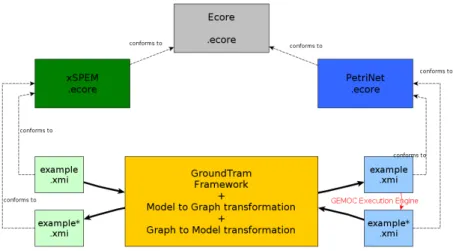
Figure 1: Expected Workflow for the example detailed in subsection 1.3
to reuse existing xDSMLs written using the GEMOC methodology and tools can provide many advantages: one still has the advantages of having a reified model of concurrency, while not having to deal with the most complex parts of designing an xDSML in the GEMOC methodology.
1.3
Example
The running example used for experimentation is the translational seman-tics of a simplified version of SPEM7
into Petri Nets.
Source xDSML SPEM is a modeling language used to model processes. The MetaModel used is visible on figure 2. A Process
owns several ProcessElements, which are either WorkDefinitions or
WorkSequences. AWorkSequencehas akindwhich is eitherstartToStart,
startToFinish, finishToStart, finishToFinish which represents the nature of the relation between its two referenced WorkDefinitions,
predecessor and successor. A WorkDefinition knows its outgoing and incoming WorkSequences and has an ExecutionState which represents the current state of theWorkDefinitionduring execution, and is either
Ready,Running, orFinished.
Target xDSML Petri Nets are a mathematical modeling language used for the description of distributed systems. In our flavour of Petri Net, whose MetaModel is visible on figure 6, aPetriNetis composed of several PetriNetElements, which are either Nodes or Arcs. Arcs are of kind either ”normal” or ”read” (when read arcs are traversed, marking of the sourcePlaceis not decremented) and link twoNodes (referencessource
andtarget). But these twoNodes must be of different natures: bothsource
7
Figure 2: MetaModel of the xSPEM xDSML
Figure 3: MetaModel of the PetriNet xDSML
andtargetcannot be aPlaceat the same time, or be aTransitionat the same time. Place andTransitionare the two concrete types of Nodes.
Places have an initialMarkingand acurrentMarking attributes encoded as integers. Nodes know about their outgoing and incomingArcs.
Previous work Faiez Zalila has created and used a bidirectional trans-formation between SPEM and PetriNet in a previous internship at NII for model-checking purposes [13]. However, the main differences with the work presented here lie in the fact that the MetaModels used are differ-ent, as we are using bidirectional EReferences (marked as EOpposite) in our MetaModels whereas Faiez Zalila was not ; and the source and target
languages SPEM and PetriNet are only examples in our case and could have been different, whereas Faiez Zalila was using Petri Nets to do model checking and therefore relied heavily on properties inherent to Petri Nets.
1.4
Rest of the document
Besides the current section ( 1), which introduces the work and its context, section 2 presents the current state of the implementation, while section 3 presents the upcoming work left to do to complete the propose workflow. Section 4 will conclude this tehnical report. Lastly, the Appendix sec-tion A is about the dead-end met when trying to use Bidirecsec-tional Trans-formations for a slightly different topic: reversable pattern-matching of events.
2
Implementation
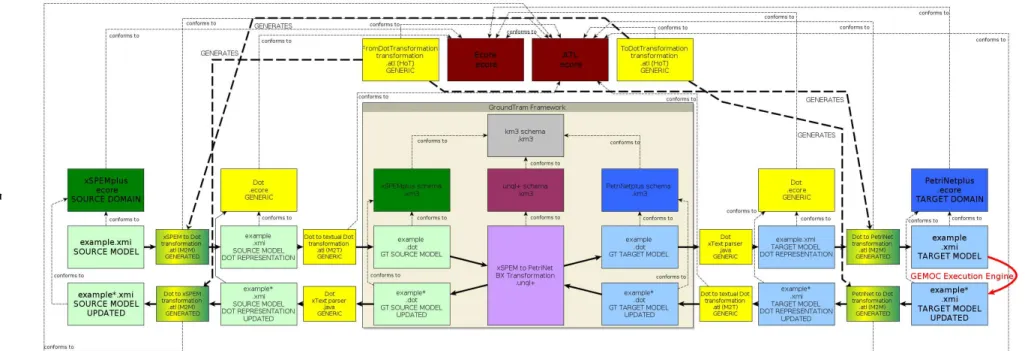
In this section are shown the current implemented elements. The overall goal can be seen on figure 4. This figure is not to be taken literally ; it is only there to illustrate the kind of structure we are supposed to have in the end. Notably, the approach using generic higher-order transforma-tions [10] and their outputs (transformatransforma-tions from model to graph and transformation from graph to model, with fixed MetaModels of respec-tively input and output) is not implemented. Instead the implementation uses a transformation which takes a MetaModel as input (interpretative approach instead of the generative approach presented in the figure).
Note: The repository containing the sources will be made available online8
once a more elaborated version of the work presented in this report has been published.
8
Figure 4: Zoomed-in view of the workflow for our example
2.1
Starting Point
The starting point of the current work is at theGT SOURCE MODEL
element of figure 4, that is the graph representation of the source model in a format the GRoundTram framework accepts as input: thus the Dot [3] graph with labels exclusively on edges. Let us use an exam-ple, refered to as ”sample 1” in the repository9
. It consists in aProcess
named ”TalkDrinkWorkExample” composed of 3 WorkDefinitions and 4WorkSequences. TheWorkDefinitions are named ”Talk”, ”DrinkCof-fee” and ”Work”. TheirExecutionState is NULL as they have not been initialized yet. In our modeled process, we may only start drinking cof-fee if we have started talking (WorkSequencestartToStart from ”Talk” to ”DrinkCoffee”) and we may finish talking only if we have finished drinking coffee (WorkSequencefinishToFinish from ”DrinkCoffee” to ”Talk”). We may also only start working if we have finished both talking and drinking coffee (WorkSequences finishToFinish from ”Talk” to ”Work” and from ”DrinkCoffee” to ”Work”).
2.2
Bidirectional Transformation
The bidirectional transformation written using GRoundTram is specific to both xSPEM and PetriNet. It takes a graph corresponding to an xSPEM model as input (the starting point mentioned earlier in subsection 2.1) and produces the equivalent PetriNet model as output. Both graphs can only have labels on edges as this is the input and output format used by the GRoundTram framework.
More precisely, a Process is transformed into a PetriNet. A
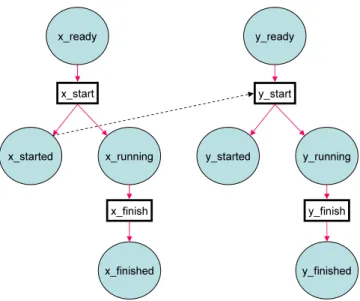
WorkDefinition named ”x” is transformed into 4 Places: ”x ready”, ”x running”, ”x started”, ”x finished” with initialMarking of 1 for ”x ready” and 0 for the other Places and currentMarking of NULL for allPlaces ; 2 Transitions: ”x start” and ”x finish” ; and 5 arcs: from ”x ready” to ”x start”, from ”x start” to ”x running”, from ”x start” to ”x started”, from ”x running” to ”x finish”, from ”x finish” to ”x finished”. The left half of Figure 6 depicts these components.
A WorkSequence is transformed into an Arc of kind ”read” from a Place to a Transition. Let us consider a WorkSequence of na-ture startToStart from the WorkDefinition named ”x” to the
WorkDefinition named ”y”. The element corresponding to this
WorkSequence is an Arc between Place ”x started” and Transition
”y start” (depicted by a dotted line in Figure 6). Had theWorkSequence
been of nature startToFinish, then it would have connected ”x start” with ”y finished”. If it had been of nature finishToStart it would have connected ”x finished” with ”y start” and if it had been of nature
finishToFinishit would have connected ”x finished” with ”y finish”. More technically, in our UnQL transformation, we first create a
PetriNet with the name of the input Process using a Select query. Inside this query there is another Select query which is in charge of creating all thePetriNetElements to place in the containment reference
elements of PetriNet. First, the easier part is creating the 4 Places,
9
{&} 58 57 Process 56 name 55 elements 54 EString 52 WorkSequence 51 WorkSequence 50 WorkSequence 49 WorkSequence 48 WorkDefinition 47
WorkDefinition
46 WorkDefinition 53 "TalkDrinkWorkExample" 31 successor 30 predecessor 29 kind 28 successor 27 predecessor 26 kind 25 successor 24 predecessor 23 kind 22 successor 21 predecessor 20 kind 45 process 44 outgoingLinks 43 name 42 incomingLinks 41 currentExecutionState 40 process 39 outgoingLinks 38 name 37 incomingLinks 36 currentExecutionState 35 process 34 name 33 incomingLinks 32 currentExecutionState Process WorkSequence WorkSequence 19 EString WorkSequence 17 ExecutionState Process WorkSequence WorkSequence 15 EString WorkSequence 13 ExecutionState Process 11 EString WorkSequence WorkSequence 9 ExecutionState WorkDefinition
WorkDefinition 7
WorkSequenceKind
WorkDefinition WorkDefinition
5
WorkSequenceKind WorkDefinition
WorkDefinition
3
WorkSequenceKind
WorkDefinition WorkDefinition
1 WorkSequenceKind 18 "Talk" 16 NULL 14
"DrinkCoffee"
12 NULL 10 "Work" 8 NULL 6 "startToStart" 4 "finishToStart" 2
"finishToFinish"
0 "finishToStart"
Figure 5: Graph representation of the input xSPEM model
x_finish x_start
x_finished x_ready
x_running x_started
y_finish y_start
y_finished y_ready
y_started y_running
Figure 6: PetriNet components created from a WorkSequence of nature startToStartfromWorkDefinitionx to y
2 Transitions and 5 Arcs corresponding to each WorkDefinition. Afterwards is the harder part which consists in creating an Arc which, depending on its kind, will have a differentsource and a differenttarget. For this, another Select query is created. This query looks up, in the elements created in the first part, the Place which has the following name: name of the predecessor WorkDefinition of the WorkSequence
concatenated with either ” started” or ” finished” depending on the kind of the WorkSequence. The Place found will be the source of the Arc
we are creating. Then, we have to look up for the Transition which will be the target of the Arc we are creating. This Transition must have the following name: name of thesuccessor WorkDefinitionof the
WorkSequence concatenated with either ” start” or ” finish” depending on the kind of theWorkSequence.
The compositionality of the UnQL language achieves the capturing of twig-like patterns to retrieve subgraphs encoding required model elements likeWorkDefinitions, as well as traversals of intermediate results created during the first part of the above transformation.
label on the edge which should lead to the EObject referenced. We choose to use the label ”EOppositeReference”. The value of this EReference will be computed later on in the transformation of subsection 2.4.
After the transformation, we have an UnCAL graph which we are able to transform into a Dot [3] graph. Unfortunately it is too big to be contained in this document, but can be found in the repository10
2.3
Transformation from graph to model
The Dot graph resulting from the output of the GRoundTram transfor-mation is still a valid classical Dot graph. Thus, tools based on classical Dot format can be used. In our case, we will use the parser for Dot tex-tual concrete syntax generated by Xtext so as to obtain an XMI model conform to the Dot MetaModel. The Dot MetaModel is independent from PetriNet or xSPEM so this parser will always be applicable to the out-put of a GRoundTram transformation. This parser can be found in the repository11
too.
2.4
Transforming from a Dot model into a
PetriNet model
Now, we need to transform the XMI model conform to the Dot MetaModel into an XMI model conform to our PetriNet MetaModel. A transforma-tion written in Java12
takes as input the XMI model conform to the Dot MetaModel and creates the PetriNet XMI model equivalent. In partic-ular, it decodes the bidirectional EReferences. EReferences which have an EOpposite but have no value attached to them in the graph are com-puted last, and by going through the whole graph looking for the opposite EReference we are able to re-construct the value of all the missing ERef-erences. For example, consider that in the input Dot model the value of the EReferencesourceof a givenArcis present, then in order to add this
Arcto theoutgoingArcs EReference of the correctNode, we have to look through all the createdNodes and compare them to the value of thesource
EReference of our Arc. When the match is found, then we can set the value of the EReferenceoutgoingArcs(with respect to its multiplicity).
Afterwards, we have found that this approach was similar to the one Wider describes in subsections 4.1 and 4.2 in [12].
3
Upcoming work
3.1
Improvements on the existing transformation
The transformation mentioned in subsection 2.4, which we can abusively call a transformation from graph to model, is not entirely decorelated from the target xDSML used as example. Therefore, it could use some slight improvements to make it truly generic and only parameterized by
10
src/examples/test.transformation/src/sample1/outputs
11
src/core/org.gemoc.translational semantics.dot.xtext/src/org/gemoc/translational semantics/dot/xtext/Parser.java
12
src/examples/test.javaparsing/src/test/javaparsing/DotXmiModelToPetriNetModel.java
the MetaModel of the target xDSML. Most of the algorithm though is still unreliant on the specific features of the MetaModel and thus these improvements should not be too big.
3.2
Transformation from model to graph
Our starting point was that of a xSPEM model encoded as a graph, but the true starting point should be of the model itself. Therefore we also need a transformation which, parameterized by the MetaModel of the source xDSML, will be able to encode models conform to the MetaModel of the source xDSML into graphs which can server as input for the bidirectional transformation.
3.3
Usage
Once the work mentioned in previous subsections 3.1 and 3.2 have been made, the generic workflow shown on figure 4 should be the following:
1. The input model conforming to the source xDSML MetaModel is transformed into a Dot model using the transformation from model to graph mentioned in 3.2
2. This Dot model is pretty-printed into the textual concrete syntax of Dot
3. The Forward Transformation of the GRoundTram Bidirectional Transformation is applied to the Dot graph obtained
4. The result of the transformation is parsed using the xText parser mentioned in 2.3
5. The output Dot model is then transformed into a model conform to the target xDSML MetaModel using the transformation mentioned in 2.4
6. A step of execution is made on this model (by the GEMOC Execu-tion Engine in our case), which typically changes the value of some EAttributes and EReferences in the model.
7. The updated model is then transformed back into a Dot model, using the same transformation as in step 1 but parameterized this time by the target xDSML MetaModel
8. The Dot model is then pretty-printed into a Dot graph as in step 2
9. The Backward Transformation of the GRoundTram Bidirectional Transformation is applied to the Dot graph obtained
10. The output Dot graph is then parsed by the parser, as in step 4
11. The Dot model obtained is then transformed back into a model con-form to the source xDSML MetaModel using the same transcon-forma- transforma-tion as in step 5 but parameterized this time by the source xDSML MetaModel
4
Conclusion
The semantics of an Executable Domain-Specific Modeling Language de-signed in a Model-Driven way can be defined in a translational way using Bidirectional Transformations implemented in GRoundTram. The gap between the technical spaces of models and edge-labeled graphs can be closed by using a set of transformations which can ultimately be reduced down to only 2 transformations specific to either the source xDSML or the target xDSML used. These two transformations can be obtained either by generation using Higher-Order Transformations, or by interpretation by providing a MetaModel as argument.
The first of these transformations is a transformation which, given a MetaModel (of our source xDSML or of our target xDSML), can transform models conform to the given MetaModel into models conforming to the Dot MetaModel (with labels exclusively on edges so as to comply with GRoundTram formats). This transformation is then used to transform the original model we want to execute into a model corresponding to an edge-labelled graph so as to be pretty-printed and served as input to the GRoundTram transformation ; this same transformation is also used to transform the executed model conform to the target xDSML after it has been modified by a step of execution so as to be pretty-printed in order to be the input of the Backward Transformation.
The second transformation is a transformation which, given the Meta-Model of the source xDSML or of the target xDSML, can transform Dot graphs (as before, with labels exclusively on edges) into a model conform-ing to the given MetaModel. This transformation is used first on the Dot edge-labeled graph obtained after the Forward Transformation so as to recreate a model conforming to the target xDSML from a graph ; it is then used as the very last step of the proposed workflow on the Dot graph resulting from the parsing of the output of the Backward Transformation so as to recreate, from the given graph, a model conforming to the source xDSML.
We have provided the first steps of implementations for this second transformation and used it successfully on the example of defining the semantics of xSPEM using PetriNets. Upcoming work should build on that and the full workflow proposed should be completed, so as to provide a fully implemented solution to the gap existing between the models and graphs technical spaces. Once refined, this workflow could be implemented in the GEMOC tools so as to provide a way to define the semantics of new xDSMLs using previously well-defined xDSMLs.
Acknowledgments
Many thanks to Professor Zhenjiang Hu of the National Institute of In-formatics. Also many thanks to Quang Minh Tran and the rest of the BX Team of NII for their inputs and discussions during this internship. Thanks to the NII International Internship Program for providing this collaboration opportunity.
References
[1] Benoit Combemale, Julien Deantoni, Matias Vara Larsen, Fr´ed´eric Mallet, Olivier Barais, Benoit Baudry, and Robert France. Reify-ing Concurrency for Executable MetamodelReify-ing. In Martin Erwig, Richard F. Paige, and Eric Van Wyk, editors, SLE - 6th Interna-tional Conference on Software Language Engineering, volume 8225 ofLecture Notes in Computer Science, pages 365–384, Indianapolis, IN, ´Etats-Unis, 2013. Springer. doi: 10.1007/978-3-319-02654-1\20. URL http://hal.inria.fr/hal-00850770. CNRS PICS Project MBSAR (http://gemoc.org/mbsar).
[2] Krzysztof Czarnecki, J. Nathan Foster, Zhenjiang Hu, Ralf L¨ammel, Andy Sch¨urr, and James F. Terwilliger. Bidirectional Transforma-tions: A Cross-Discipline Perspective. InInternational Conference on Model Transformation (ICMT 2009), pages 260–283. LNCS 5563, Springer, 2009.
[3] John Ellson, Emden R. Gansner, Eleftherios Koutsofios, Stephen C. North, and Gordon Woodhull. Graphviz and Dynagraph - Static and Dynamic Graph Drawing Tools. InGRAPH DRAWING SOFT-WARE, pages 127–148. Springer-Verlag, 2003.
[4] D. Harel and B. Rumpe. Meaningful modeling: what’s the semantics of ”semantics”? Computer, 37(10):64–72, Oct 2004. ISSN 0018-9162. doi: 10.1109/MC.2004.172.
[5] S. Hidaka, Zhenjiang Hu, K. Inaba, H. Kato, and K. Nakano. Groundtram: An integrated framework for developing well-behaved bidirectional model transformations. In Automated Software Engi-neering (ASE), 2011 26th IEEE/ACM International Conference on, pages 480–483, Nov 2011. doi: 10.1109/ASE.2011.6100104.
[6] Soichiro Hidaka, Zhenjiang Hu, Kazuhiro Inaba, Hiroyuki Kato, Kazutaka Matsuda, and Keisuke Nakano. Bidirectionalizing Graph Transformations. In ACM SIGPLAN International Conference on Functional Programming, pages 205–216. ACM, 2010.
[7] Soichiro Hidaka, Zhenjiang Hu, Kazuhiro Inaba, Hiroyuki Kato, and Keisuke Nakano. GRoundTram: An Integrated Framework for Developing Well-Behaved Bidirectional Model Transformations.
Progress in Informatics, (10):131–148, March 2013. URL http: //dx.doi.org/10.2201/NiiPi.2013.10.7.
[8] Zhenjiang Hu, Andy Sch¨urr, Perdita Stevens, and James F. Ter-williger. Dagstuhl seminar on bidirectional transformations (bx).
SIGMOD Record, 40(1):35–39, 2011.
ISBN 978-1-4503-0445-0. doi: 10.1145/1985793.1985858. URLhttp: //doi.acm.org/10.1145/1985793.1985858.
[10] Massimo Tisi, Fr´ed´eric Jouault, Piero Fraternali, Stefano Ceri, and Jean B´ezivin. On the use of higher-order model transformations. In
Proceedings of the 5th European Conference on Model Driven Ar-chitecture - Foundations and Applications, ECMDA-FA ’09, pages 18–33. Springer-Verlag, 2009.
[11] Markus Voelter, Sebastian Benz, Christian Dietrich, Birgit Engel-mann, Mats Helander, Lennart C. L. Kats, Eelco Visser, and Guido Wachsmuth.DSL Engineering - Designing, Implementing and Using Domain-Specific Languages. dslbook.org, 2013. ISBN 978-1-4812-1858-0.
[12] Arif Wider. Implementing a Bidirectional Model Transformation Language as an Internal DSL in Scala. In K. Sel¸cuk Candan, Sihem Amer-Yahia, Nicole Schweikardt, Vassilis Christophides, and Vincent Leroy, editors, Proceedings of the Workshops of the EDBT/ICDT 2014 Joint Conference, number 1133 in CEUR Workshop Pro-ceedings, pages 63–70, Aachen, 2014. URL http://ceur-ws.org/ Vol-1133#paper-10.
[13] Faiez Zalila and Soichiro Hidaka. Facilitating verification results feed-back onDSMverification context using bidirectional model
transfor-mation. unpublished manuscript, February 2013.
A
Pattern matching of events using
Bidi-rectional Transformations
Context We wanted to be able to create pattern matching of events from low-level events into higher-level events. We also needed to be able to reverse these patterns, so that according to another specification referencing higher-level events we could intervene on the lower-level events. For examples one such pattern matching could be
e1+e2→F1
meaning that the coincidence of an occurrence of evente1with an
occur-rence of evente2 would trigger an occurrence of eventF1; e2|e3→F2
meaning that the union of an occurrence of evente2 with an occurrence
of event e3 would trigger an occurrence of event F2. Then, in another
specification, we needed to be able to compute the reverse ofF1orF2.
Problem Although there are difficulties in how to define the reverse of e2|e3, this was not the main problem here. The main problem was
that we needed to be able to compute the reverse of, say, F2 without
having had an occurrence of F2 actually happen beforehand.
This simple need (both specifications relative to the same higher-level events not being executed in sequence) is incoherent with the way the backward semantics of GRoundTram are done, relying on traces of the forward transformation [6].